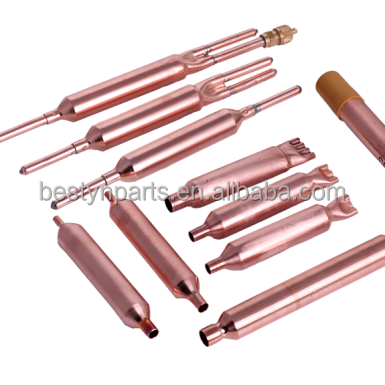
Refrigeration air conditioning systems rely on four main parts working together. First up is the compressor, which functions kind of like the system's heart. It takes refrigerant gas and pumps it under pressure to start the whole cooling process going. After that comes the condenser unit, usually mounted outside buildings, where hot vapor turns back into liquid by releasing heat to the environment. Inside the evaporator coil, liquid refrigerant picks up warmth from whatever needs cooling, creating that chill effect we all want. Between these stages sits the expansion valve, controlling how much refrigerant flows through different pressure areas. Industry reports from last year indicate that when manufacturers install precision machined compressors instead of standard models, they see around 18 percent better energy performance overall.
The refrigerant lines link all those important parts together, making those phase changes happen that's so crucial for moving heat around the system. We've seen a big shift lately with R-454B refrigerant cutting down on global warming potential by almost four fifths when compared to what we used back in the day according to ASHRAE data from last year. Most folks still go with copper tubing because it conducts heat well and doesn't corrode easily, but interestingly enough about a third of commercial setups now incorporate aluminum alloys instead. Makes sense really since saving weight matters a lot in certain applications, even if it means sacrificing just a little bit on performance.
| Component | Function | Efficiency Impact |
|---|---|---|
| Compressor | Increases refrigerant pressure | Affects 40% of system COP |
| Condenser Coils | Dissipates heat | Dictates 25% of heat transfer |
| Expansion Valve | Controls refrigerant flow rate | Impacts temperature stability |
These parts operate in a closed-loop thermodynamic cycle, where coordinated performance determines cooling capacity and energy use. The refrigeration cycleâs principles explain how electrical energy is converted into cooling through phase changes. Proper integration prevents energy losses responsible for 63% of premature system failures (HVAC Tech Journal 2023).
High quality compressors are built using either forged steel or aircraft grade aluminum materials that can handle pressures above 400 PSI without failing. Most top brands stick to ASHRAE Standard 15-2022 when it comes to how thick the materials need to be and making sure those joints hold up under stress. This is particularly important around parts like valve plates where things get really intense, plus bearing housings which take a lot of punishment too. When looking at condenser and evaporator coils, we find something interesting happening with hydrophilic coated copper. These actually resist corrosion about 32 percent better than regular old aluminum during those harsh salt spray tests according to research published in the HVAC Tech Journal last year.
Superior coils feature:
Industrial-grade components must endure 50,000+ thermal cycles and vibrations exceeding 3.5 G-force without failure. Accelerated lifecycle testing shows compressor valves maintaining less than 0.001" deflection after 15,000 hours correlate with 15-year service life in commercial environments.
Third-party validation from NAFB-certified laboratories reveals that 18% of premium-branded components underperform generic alternatives in SEER maintenance and leak resistance. Always verify manufacturer claims against independent IEC 60335-2-40 certification reports before selecting replacement parts.
OEM compressors, those made by Original Equipment Manufacturers, are built right into the system they work with, which means they handle pressure ratios and temperature control pretty well. Some independent studies have found that these OEM units tend to be around 12 to maybe even 15 percent more efficient when it comes to energy use after about five years than the cheaper generic alternatives out there according to research from Deerfields back in 2023. But wait there's another angle here too. For situations where things aren't so mission critical, some certified aftermarket compressors actually perform just as good as OEM ones. These aftermarket parts often use high quality aerospace materials similar to what goes into planes and spacecraft. Tests on commercial freezers showed that roughly 92 percent of them had cooling power equal to their OEM counterparts, though obviously there will always be some variation between different brands and models.
Top-tier aftermarket parts deliver 80â90% of OEM functionality at 35â50% lower cost, particularly in:
Recent HVAC performance benchmarks show high-end aftermarket expansion valves improving system SEER ratings by 0.8â1.2 points when paired with R-454B refrigerant, offering measurable efficiency gains beyond cost savings.
According to ASHRAE field data, 25% of refrigeration failures stem from mismatched aftermarket parts. Common issues include:
These problems often emerge 6â18 months post-installation, creating a false economy compared to OEM solutions with documented MTBF exceeding 60,000 hours.
Getting the right match between voltage levels, cooling power, and refrigerant types is really important for keeping systems running smoothly. When things don't line up properly, efficiency drops significantly around 23% according to research from Ponemon Institute back in 2023, plus there's a much higher chance of compressor breakdowns happening. Take for instance when someone installs a 208 volt compressor into a setup designed for 240 volts - this puts extra strain on those motor windings inside. And then there's the problem with mixing refrigerants like putting R-410A into equipment meant for R-22, which creates all sorts of chemical issues down the road. That's why so many companies have started adding these handy digital compatibility tools right into their installation guides these days. These little helpers walk technicians through each step to make sure nothing gets mismatched before turning anything on.
| Matching Criteria | Installation Success Rate |
|---|---|
| OEM part + factory specs | 98% |
| Generic replacement | 64% |
| 2024 HVAC Replacement Parts Study |
Cross-referencing serial numbers against manufacturer databases reduces incompatible installations by 82%. "Universal fit" third-party parts often lack precise metering valve calibrations or correct coil spacing, leading to refrigerant maldistribution and frost buildup.
Variable-speed expansion valves combined with microchannel coils boost SEER ratings by 15â18% compared to fixed-orifice systems (AHRI 2024). Coils with hydrophilic coatings enhance heat transfer by 12% while lowering airflow resistance. These improvements highlight how component-level upgrades directly influence overall system efficiency and operating costs.
The length of a warranty often shows how much faith a manufacturer has in their product lasting over time. Parts that come with 3 to 5 year guarantees usually go through pretty intense testing for defects and wear and tear, which matches what we expect from important components such as compressors or coils. According to research published by McKinsey & Company in 2023, equipment with proper warranties needed about 34 percent less emergency fixes because these items meet better quality benchmarks. When a warranty includes both labor costs and part replacements, it tells us something about the company's commitment to customer service. This matters a lot in business settings where every hour lost to system failure can cost around $740 on average according to Ponemon Institute data from last year.
Leading manufacturers operate ISO 9001-certified facilities and offer robust technical support, including:
Third-party verification through organizations like AHRI (Air-Conditioning, Heating, and Refrigeration Institute) confirms compliance with ASHRAE benchmarks, making certification a trusted indicator of quality.
Maximizing lifespan requires:
A 2024 reliability engineering study showed predictive maintenance reduces compressor replacement rates by 41% versus reactive repairs. Always use OEM-specified lubricants and components during servicing to preserve warranty coverage and system performance.
 EN
EN


 Hot News